


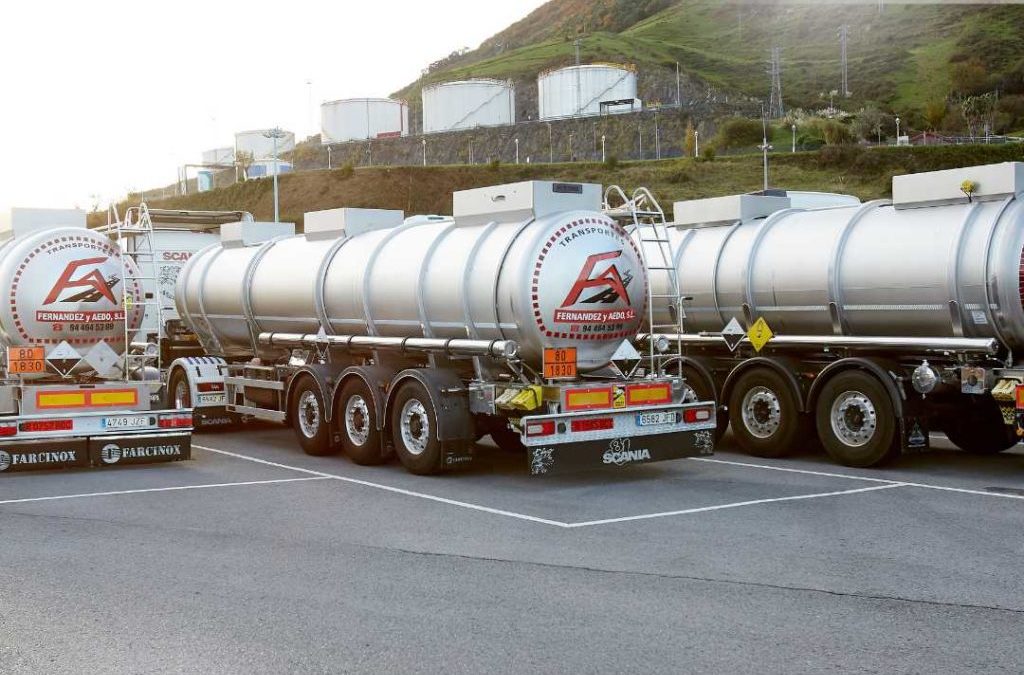
During 2022, the tank transport market has experienced a number of fluctuations in demand in each of its specialties. In particular, companies in the sector have been affected by rising energy prices, which has been a major challenge for them.
According to the Spanish Confederation of Freight Transport (CETM), there was a shortage of drivers, trucks and tankers last year, and fuel prices rose considerably. Russia’s invasion of Ukraine has added another factor of instability, which has upset all forecasts of stability and is generating uncertainty, inflation and out-of-control energy costs, along with imbalances in freight flows.
According to José Luis Ruiz, the vice-president of Químicos, “it was a very busy year for our speciality; at least for the first 9/10 months of the year we had a very high level of activity. Moreover, I believe that the circumstances were right for us to be able to raise tariffs and thus recover part of the margins that had been lost in recent years, but this task has to continue and it will be a very long-term task, provided that there are no downturns in activity that make the sector nervous. But I insist, it will be the only way to guarantee that we can count on drivers and meet the very significant cost increases that we have been suffering since the pandemic and that have been aggravated by the war in Ukraine. In conclusion, there was activity and improved rates, but also a significant increase in costs”.
In terms of tank registrations, the effects of the pandemic are still evident. In both 2021 and 2022, the number of 100 registrations was not reached in any month. Moreover, the year-on-year development shows no signs of recovery, but rather the opposite. While in 2020 more than 800 units or very close to this figure were registered, in 2021 it hovered around 750 registrations, and although the average rose during the first six months of 2022 compared to 2021, it has decreased in the last months, which is not a good sign. As a result in 2022, enrolments are 4% lower than in 2021 and around 9% lower than in 2020.
What does 2023 look like?
2023 is characterised by a year of uncertainty, due to a number of factors that we have already mentioned above and that are still carried over from last year. One of the factors that will determine how the rest of the year evolves will be the way in which the global energy situation is resolved.
Despite economic indicators forecasting an economic downturn, activity seems to continue unabated.
It will build on the progress made during 2022 and aims to establish a solid basis for customer relations in the future.
Structural problems in this sector persist, especially in relation to the shortage of drivers, which requires major changes such as the promotion of multimodality, particularly in Spain, where we are considerably lagging behind.
On the other hand, it is expected that work will continue on improving road safety and reducing the environmental impact of operations, as well as ensuring good working conditions.
If you would like more information about dangerous goods transport or any of our services, please do not hesitate to contact us.