

-
A spill during the transport of dangerous goods is one of the situations that can most quickly turn an operational incident into an emergency.
When dealing with an ADR tanker, the response cannot be based on improvisation. The appropriate action depends on the goods being transported, their properties, the quantity involved, the location of the incident, environmental conditions and the level of risk presented by the situation.
That is why, in the event of a spill, the first priority is to protect people and properly assess the situation before taking action.
ADR 2025 establishes a common framework for the international road transport of dangerous goods and regulates, among other aspects, transport conditions, driver training, equipment, documentation and emergency procedures.
In Spain, the new Basic Civil Protection Planning Guideline for the risk of accidents involving the land transport of dangerous goods, published in April 2026, expressly classifies as type 3 any leak or spill of transported dangerous goods when there is no fire.
The first few minutes after an ADR spill
When a leak or spill occurs, the first question should be:
What goods are involved and what risk do they present?
The behaviour of a flammable liquid, a corrosive product or a toxic substance can be completely different.
The response should therefore begin by assessing the situation and consulting the available information.
ADR requires the crew, in an emergency, to follow the measures set out in the written instructions whenever it is safe and practicable to do so.
In general terms, the response should prioritise:
- The safety of the crew and people nearby.
- The initial assessment of the incident.
- Identification of the goods.
- Application of the relevant instructions when it is safe to do so.
- Communication with the emergency services.
- Taking control measures only when they can be carried out without creating additional risks.
Direct intervention with the product should not automatically become the priority.
In some situations, keeping a safe distance, isolating the area and providing accurate information is a much safer response than attempting to control the spill personally.
What should the driver check?
The ADR written instructions are one of the key elements when dealing with an emergency during transport.
ADR requires them to be kept in the vehicle’s cab and to be readily available to the crew. They must also be provided in a language that each crew member can read and understand, and the crew must be familiar with them before starting the journey. The currently applicable version is ADR 2025.
You can consult the official and updated version of the ADR written instructions here: ADR Written Instructions — UNECE
The available information should make it possible to identify the applicable emergency measures and facilitate communication with the emergency response services.
Identifying the goods is also essential.
In an emergency, knowing the product makes it possible to assess its risks and select the appropriate intervention methods.
Identifying the goods: essential information
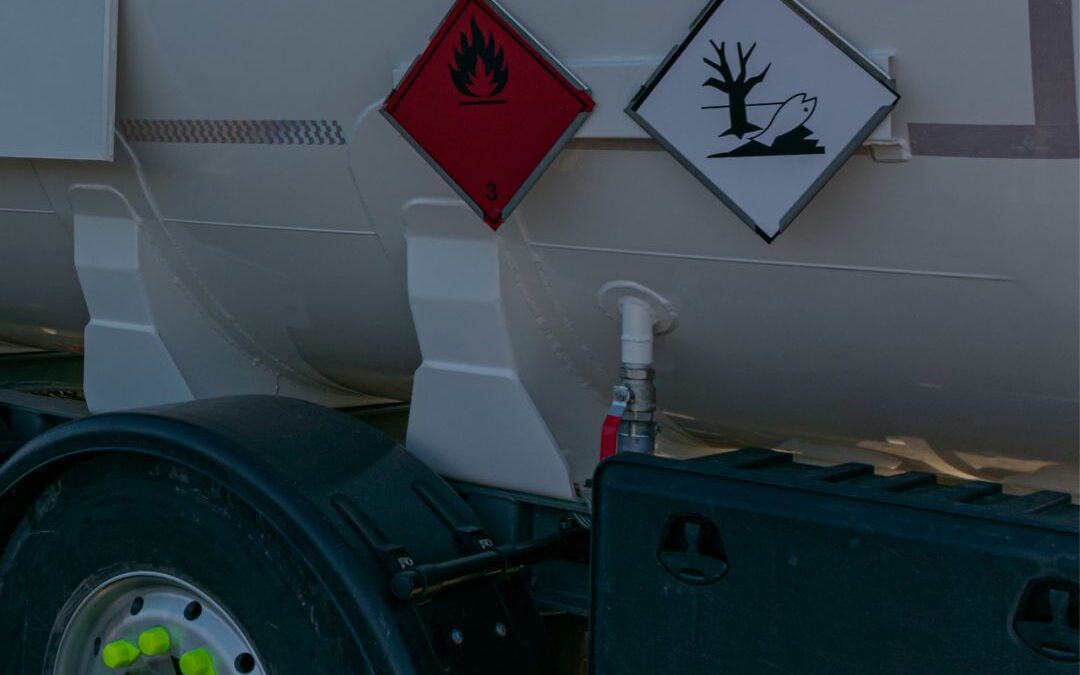
Dangerous goods are classified according to the risks they present and identified through different signs and documentation.
The UN number, hazard class, relevant panels and labels, and transport documentation provide essential information for identifying the load.
This information becomes particularly important when emergency services are involved and need to quickly determine which substance is present.
In Spain, regulations establish that an accident report must include information such as the location of the incident, the condition of the vehicle, the characteristics of the accident, details of the dangerous goods being transported and the presence of any casualties.
Correctly identifying the goods is therefore not simply a documentation issue.
It is operational information that is essential to emergency management.
Containing a spill is not the same as decontamination
Two concepts should be distinguished: containment and decontamination.
Containment aims to limit the spread of the product and prevent the incident from extending to other areas.
Decontamination is a subsequent stage and involves treating surfaces, equipment or areas that have been affected.
This may involve:
- Product recovery.
- Removal of contaminated materials.
- Surface cleaning.
- Waste treatment.
- Subsequent management of the materials used during the intervention.
The specific response always depends on the substance involved.
INRS toxicological data sheets clearly illustrate this difference: certain products call for the use of inert absorbent materials, while major spills may require evacuation and intervention to be limited to trained and properly equipped personnel.
Therefore, the same procedure cannot be applied to every type of dangerous goods.
Do all spills require the same response?
No.
The response depends on several factors:
The nature of the goods
A flammable liquid does not present the same risks as a corrosive product or a toxic substance.
The quantity spilled
The scale of the incident determines the appropriate response and the resources required.
The location
A spill in an open area presents a different scenario from an accident in an enclosed space, an industrial area, on a road or near a watercourse.
Environmental conditions
Temperature, wind and ventilation can influence the behaviour and dispersion of certain products.
Whether it is safe to intervene
Direct intervention should only be considered when it can be carried out without compromising people’s safety.
For different chemical products, INRS recommends measures such as evacuation, ventilation, elimination of ignition sources and the use of specific equipment by trained personnel when the spill is significant.
This demonstrates a fundamental principle: the response must be adapted to the product and the specific circumstances.
Five mistakes that can make a spill worse
Speed is important in an emergency, but acting quickly without the necessary information can increase the risk.
1. Intervening before identifying the product
Knowing the substance makes it possible to assess its hazards and consult the appropriate emergency measures.
2. Approaching without assessing the risk
A product may generate vapours, present a fire risk or cause harm through contact.
3. Using materials without checking their compatibility
Absorbent materials and equipment used during the intervention must be suitable for the substance.
INRS toxicological data sheets show that the recommended materials may vary depending on the product and that certain materials should even be avoided in specific emergency situations.
4. Allowing the product to spread
Where it is safe to do so and the procedure provides for it, limiting the spread of the spill can be important in reducing its consequences.
5. Delaying communication
Emergency services need accurate information to assess the situation and prepare their response.
Spanish regulations establish the main information that must be provided when reporting an accident.
Driver training is part of the response
Emergency equipment is a fundamental part of preparing an ADR vehicle.
But equipment alone is not enough: drivers also need to know how to use it correctly.
ADR establishes specific training requirements for drivers of vehicles transporting dangerous goods, including knowledge aimed at reducing the likelihood of incidents and enabling an appropriate response in an emergency.
At Fernández y Aedo, ongoing driver training is an integral part of the way we work.
This preparation enables drivers to understand:
- The risks associated with the goods.
- The emergency instructions.
- The information they need to provide.
- The applicable procedures.
- The situations in which they should intervene.
- The situations in which the priority should be to remain safe and wait for specialist emergency services.
Training therefore complements equipment.
What happens after the spill has been brought under control?
Controlling the product is an important stage of the emergency, but further work may still be required.
Depending on the incident, it may be necessary to address:
Product recovery.
Removal and management of contaminated materials.
Cleaning and decontamination of the area.
Waste management.
Incident documentation.
Investigation of the causes.The final stage is particularly important for prevention.
In France, TMD regulations require certain dangerous goods transport accidents to be reported and provide for a report including an analysis of the causes and recommendations aimed at preventing similar accidents from happening again.
A properly analysed incident can therefore become a source of information for improving future procedures.
What if the transport takes place in France?
ADR provides a common international framework, but France also has complementary national provisions.
The French Ministry for Ecological Transition explains that the land transport of dangerous goods is governed by ADR and that its implementation in France is also regulated by the TMD Order of 29 May 2009, as subsequently amended.
This is particularly relevant for companies transporting goods between Spain and France.
In addition to knowledge of ADR, it is necessary to understand the national provisions that apply to the operation and incident management.
At Fernández y Aedo, we operate from Leioa in the national and international transport of chemical liquids, with a particularly strong presence in the French market.
We have a specialised fleet for the European transport of ADR and non-ADR chemical liquids, together with tracking and recording systems designed to ensure product traceability throughout transport.
You can find out more about how we work: